Gigaverse is an interactive livestream platform designed to help creators build communities around shared interests. Unlike traditional streaming platforms that prioritize broadcasting, the vision behind the product was to create spaces where audiences could actively participate in conversations, activities, and events.
As the platform began entering the market, the team wanted to strengthen how communities form and interact within the product. My role focused on improving the core user experience so that livestreams would feel less like one-way broadcasts and more like collaborative community experiences.
Problem
Shortly after launch, the platform attracted new users, but engagement patterns revealed an important gap. While people were joining livestream sessions, most slipped into passive viewing behavior or churned shortly after signing up.
User interviews and session data revealed three recurring patterns. First, the platform’s core value proposition was not clearly communicated within the experience itself. Second, the product felt primarily creator-centric rather than community-driven. Third, although the platform offered several features, they appeared as disconnected tools rather than part of a coherent participation system.
As a result, many users struggled to answer a simple question:
“What am I here to do?”
For community hosts, this created another challenge. Even when sessions were interesting, it was difficult to convert casual viewers into recurring participants.
We reframed the problem around three fundamental ingredients of healthy communities:
• a shared sense of purpose
• a feeling of belonging
• simple ways for members to contribute and be recognized
Without these foundations, additional features only increased complexity without improving engagement.
Design Principles
Before moving into solution design, the team aligned on a set of guiding principles that would shape how the platform should behave.
A key principle was shifting the experience from passive consumption toward active participation. Instead of designing livestreams purely as viewing experiences, interactions such as chat, polls, and speaker invitations were treated as entry points that gradually move users from observing a session to contributing to it.
Another important idea was that communities need visible identity. Research showed that users often joined sessions without understanding the broader context of the community behind them. The experience therefore needed to clearly communicate why the community exists, who participates in it, and how new members can get involved.
We also focused on making participation visible and meaningful. When contributions remain hidden, members have little incentive to engage. The design introduced lightweight recognition mechanisms that highlight questions, ideas, and shared resources so members can see the impact of their contributions.
Finally, reducing friction for hosts became a critical objective. Community leaders should spend their time guiding conversations rather than managing complex tools. Workflows such as starting a session, launching polls, and moderating discussions were simplified so hosts could focus on facilitating interaction.
Together, these principles guided the transition from a broadcast-oriented product toward a community-driven platform.
Process
To address the challenge, we followed a structured UX process focused on understanding participation barriers and testing new interaction patterns.
The research phase combined qualitative interviews with behavioral data. We spoke with potential community hosts including podcasters, niche interest leaders, and meetup organizers to understand how they create engaging discussions. We also observed real user behavior during live sessions to identify where participation typically breaks down.
These insights were complemented by product analytics, including onboarding completion rates, registration drop-off points, and interaction levels during users’ first livestream sessions.
We also examined participation models from platforms such as Discord and Twitch to understand how successful communities create belonging and encourage repeat engagement.
Research findings informed a series of hypothesis-driven design iterations. Low-fidelity wireframes, user flow diagrams, and interactive prototypes were tested through usability sessions and pilot launches with selected communities.
Instead of focusing purely on interface feedback, each iteration was evaluated based on behavioral signals such as participation levels, session retention, and repeat attendance.
Scope of Design Work
My work focused on designing and improving the core interaction flows that shape how users participate in communities.
These included the process of starting and managing livestream sessions, discovering and navigating communities, interacting during live events, and supporting monetization for creators.
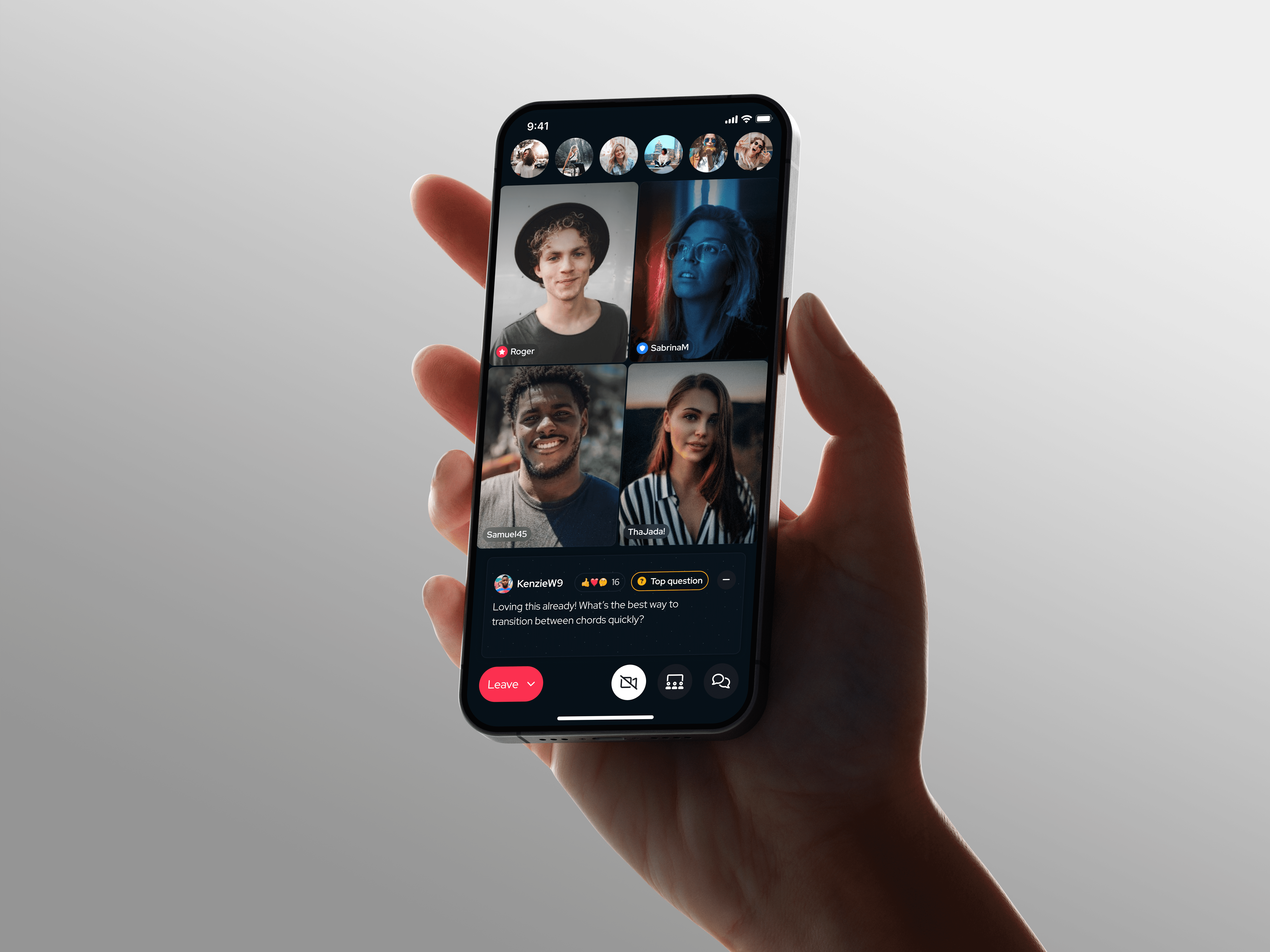
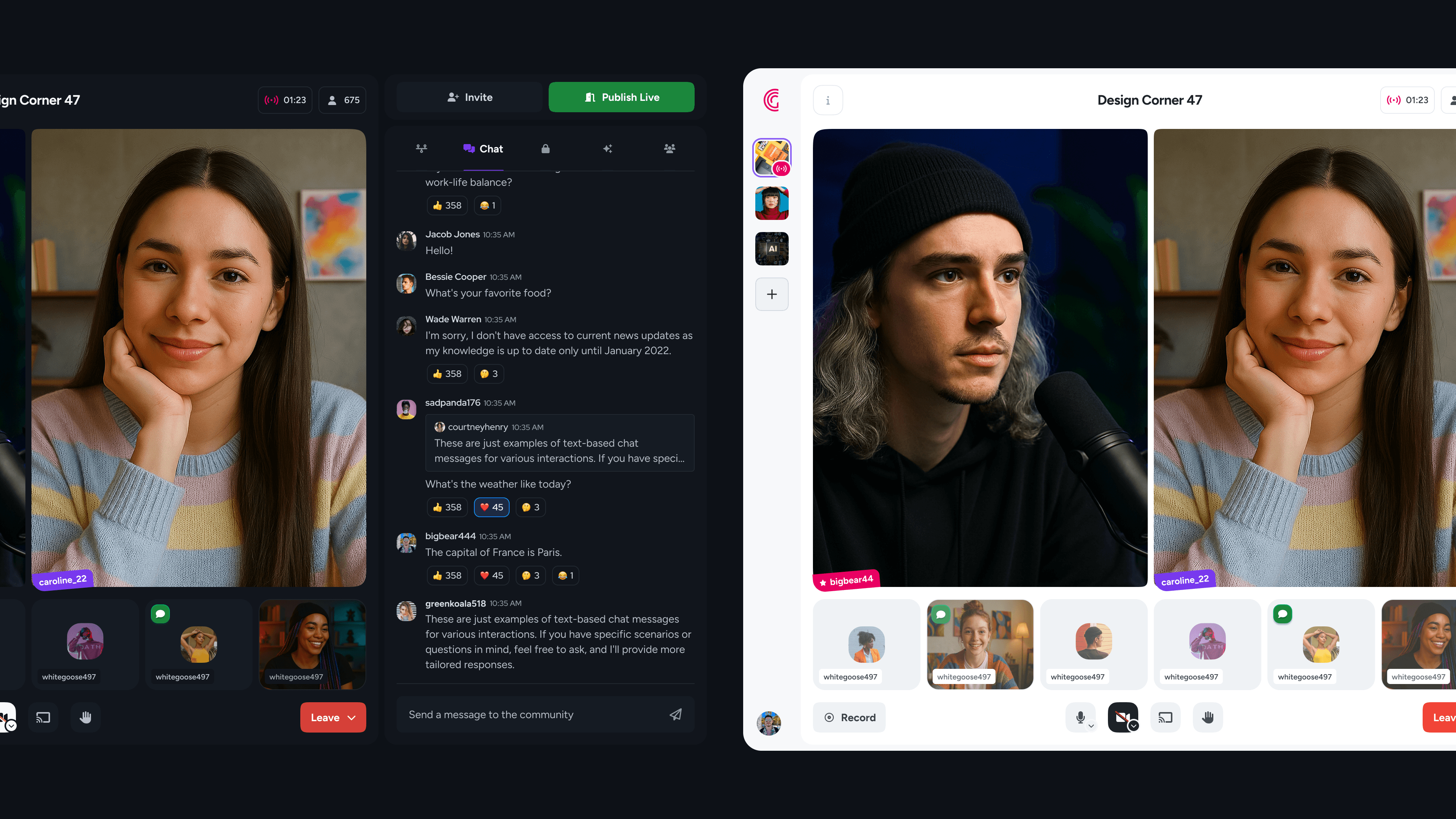
The livestream experience required balancing multiple interaction layers, including video, chat, reactions, and real-time participation tools. The goal was to make these features feel intuitive without overwhelming users.
I also designed flows for community discovery and member interaction, ensuring that users could move naturally between viewing content, participating in conversations, and contributing to the broader community.
Livestream Experience
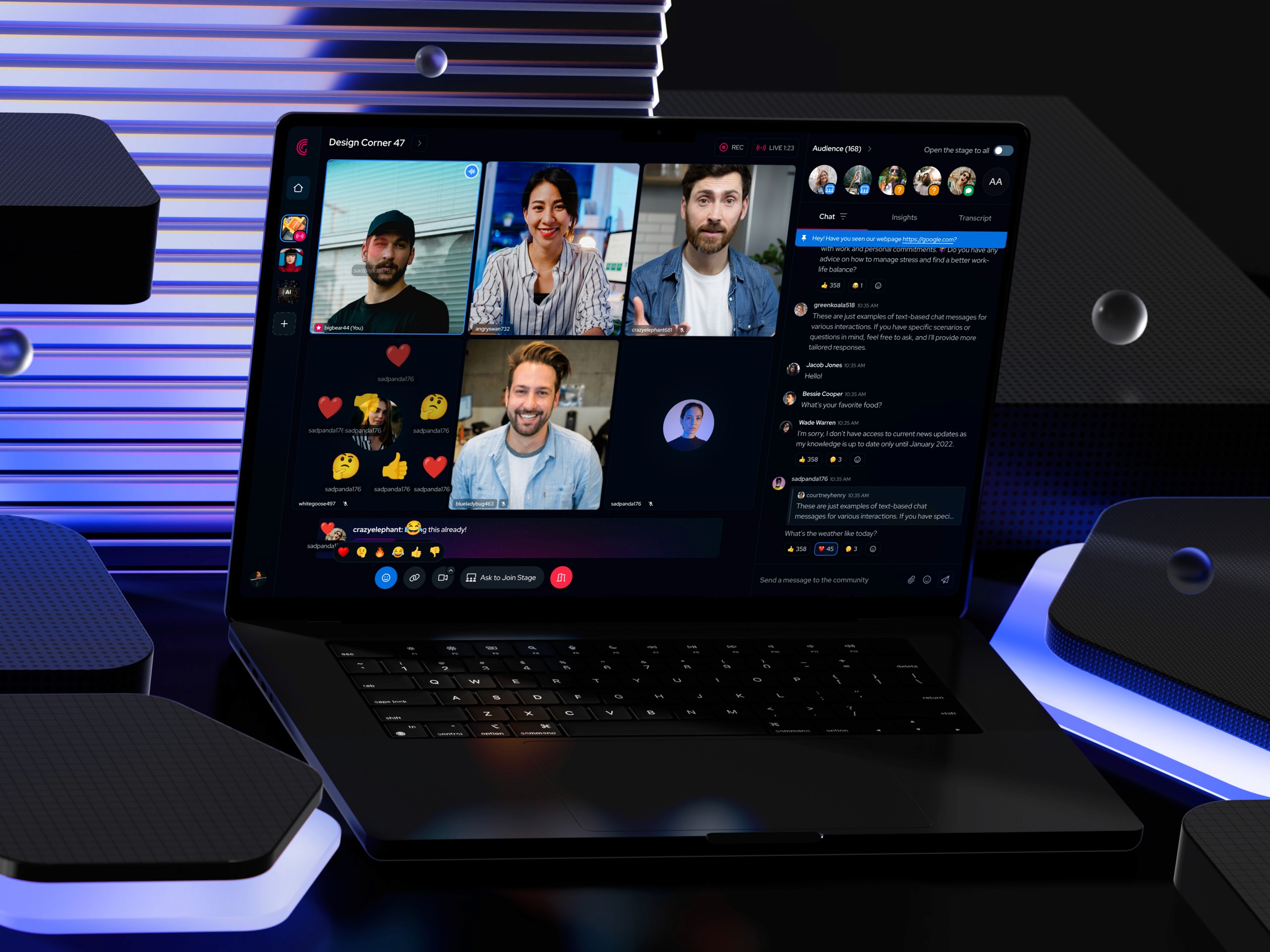
The livestream interface became the central environment where community interaction takes place.
The design balances video content with participation tools such as chat, reactions, polls, and speaker requests. These elements were intentionally integrated into the same interaction space so members could respond quickly without leaving the conversation.
Polls and interactive prompts were designed as lightweight interventions that allow hosts to invite participation during moments of discussion.
This approach transforms livestreams from static broadcasts into collaborative events where members actively shape the conversation.
Design System
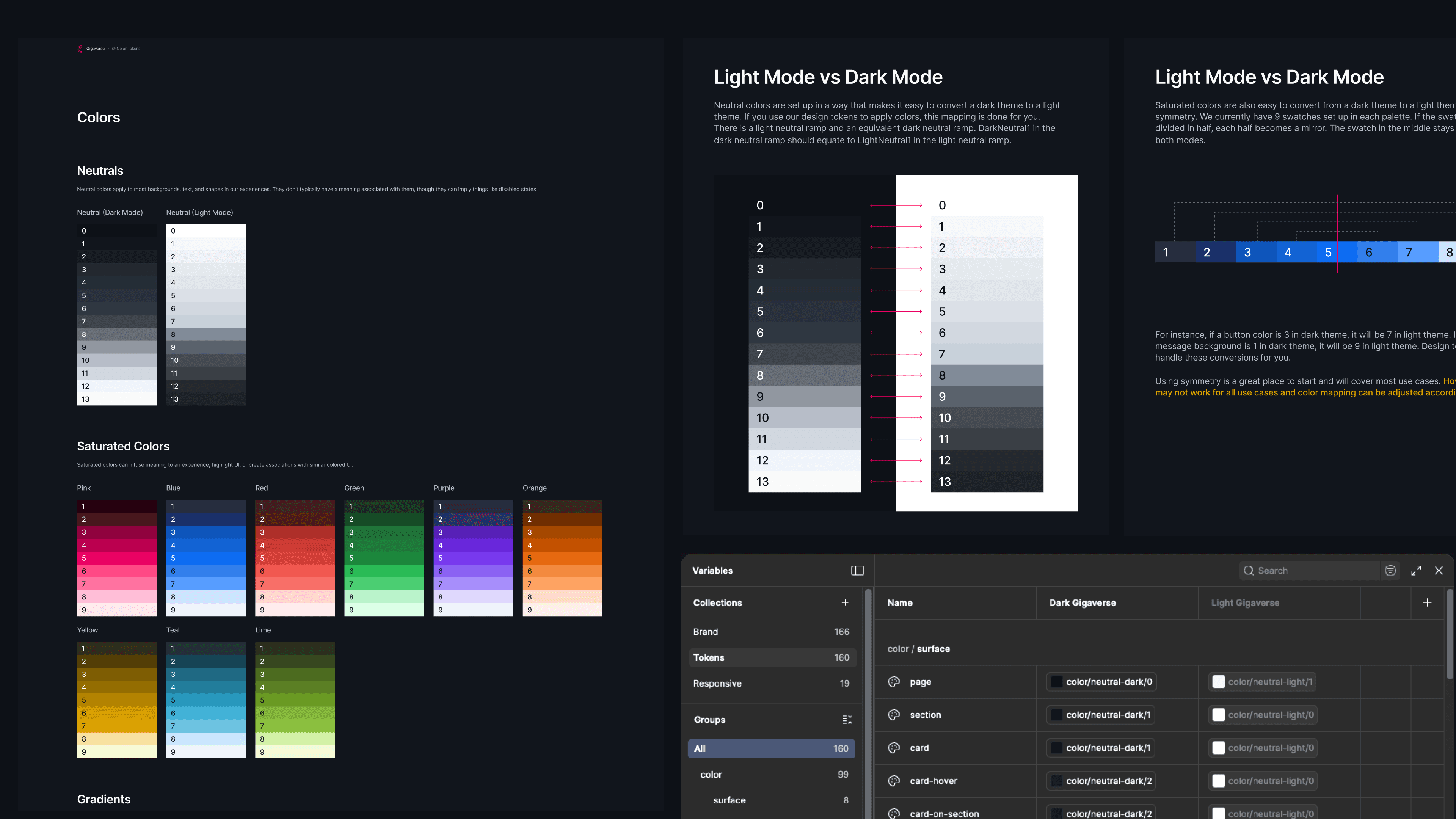
To support scalability across the platform, I created a design system based on a structured token taxonomy.
The system defined tokens for color, typography, spacing, component states, and interaction behaviors. This approach allowed the interface to adapt consistently across both web and mobile platforms.
The token structure enabled automatic switching between light and dark mode, dynamic font scaling for accessibility, and consistent UI behavior across devices.
Because tokens were implemented at the system level, visual updates and accessibility improvements could be applied globally without redesigning individual screens.
Results
Pilot communities that adopted the redesigned participation flows showed clear behavioral improvements.
Members interacted more frequently during livestream sessions, shifting from passive viewing toward active contribution. Hosts reported that conversations became more dynamic as members started asking questions, sharing ideas, and volunteering to join discussions.
In one pilot community, weekly session attendance increased significantly and session drop-off decreased as participation tools were introduced. Time spent on the platform also increased, suggesting that users were finding greater value in community interactions.
Qualitative feedback also shifted. Members began describing the platform as “our space” rather than simply a creator channel, indicating a stronger sense of community ownership.
Reflection
This project reinforced an important insight about designing community products: features alone cannot drive engagement without a clear sense of purpose and belonging.
By redesigning workflows around participation, recognition, and community identity, the platform evolved from a creator-centric broadcasting tool into a collaborative environment where members actively shape the experience.
Future iterations will focus on improving personalization, expanding the community knowledge system that preserves insights from livestream discussions, and refining recognition mechanisms so that contributions remain visible and meaningful.
The shift toward a community-first experience created stronger engagement signals and established a foundation for long-term growth.